Everyone has two cents to put in on how to do things. Here’s mine. If you want to give me change back, so be it.
I have been informed (by a pro?) that butt welding the floor pans in is the way all of the pro shops are doing it. Well, let’s see. Hmmmm…
With the little background I have in machining and welding, I have always been taught that the weakest point when welding two pieces together is at the weld. Not the weld itself, but right next to it. It has to do with metalurgy that I am not going to delve into, but rather make the point that it is where the weakest point is.
Lets look at this illustration that I put together.
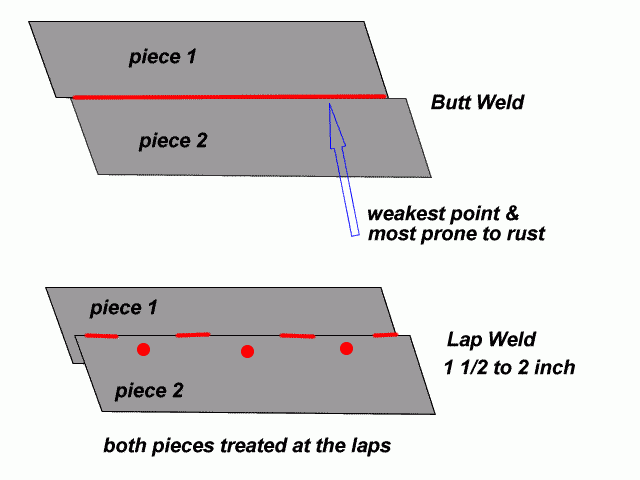
The greatest stress on a car body is the twist that happens during excessive excelleration. One quick point – it’s silly to have a muscle car and not flex its muscles. So… twist is going to occur. If someone butt welds their floor pans in, I am not convinced that is the strongest method. Yes – it looks the best, cleans up the best in appearance, and is probably the most “stock” look you can achieve. But, I am not sold on it being the best way.
In the above illustration you can see how a butt weld could be weak. Everyone knows that rust will occur next to the weld, and the weakest point is next to the weld. Why would I want the stress from the body twisting on that weld?
i’ve checked with some shops and they lap weld as I am pointing out. I don’t know if their theory is the same as mine, but hey, gotta love this country!
I was told by a pro(?) that if I lap weld, I should seam weld the top and bottom completely. I have a real problem with that advice. If I completely seam the top, I will essentially have the same effect as the butt weld. If I completely seam weld top and bottom, I will create an area for condensation to form with no way to escape and thus creating the perfect breeding bed for rust.
“MY” approach to this is simple. I lapped the new pan with the remaining body metal about 1 1/2 inches. I then treated the two pieces with POR15. I laid the new pan in place once it had cured, and seam welded for about 1 to 2 inches every six inches around. I then took my spot weld bit and drilled a 3/8 inch hole about an inch below the seam and between all the seams. Drill just the new pan metal. Then I plug welded all the holes. This gives the stress distribution to two different points of weld and not on one continuous weld. I will then seal the top ONLY with body sealer and leave the bottom, underneath, alone. I want it open to air. This way when condensation or moisture of any kind is introduced to the area, it will have a place to escape and air to keep it dry. With it being treated, it should last for many years to come.
But that’s just MY opinion.

